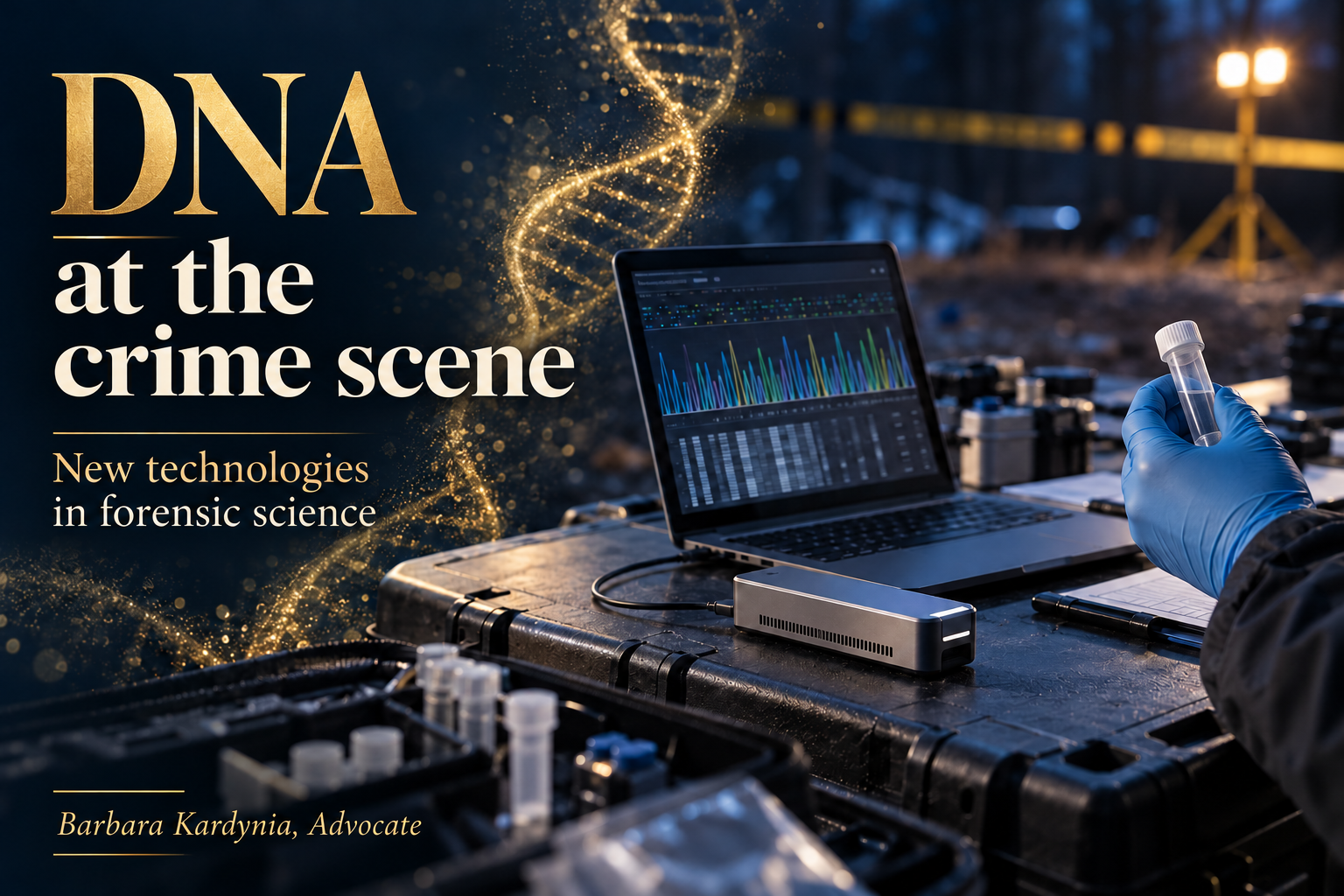
A small device connected to a computer, a secured sample and genetic data appearing on screen while the test is still running. Portable DNA sequencing opens up new possibilities for forensic science. But does this mean that an offender can be identified within a few hours, directly at the crime scene? The reality is more complex, and speed is only one factor in assessing the usefulness of an analysis.
DNA testing has long helped identify individuals and human remains and check accounts of events. Technological advances allow some analytical capabilities to move beyond the traditional laboratory. One such approach is nanopore sequencing, associated with devices including Oxford Nanopore Technologies’ MinION.
This technology reads DNA sequences from changes in ionic current as a molecule passes through a microscopic pore. Software converts the recorded signal into information about the order of the building blocks of DNA. Data can be analysed during sequencing, without waiting for the entire run to finish.
Portability and real-time access to data offer the prospect of obtaining information useful to investigators more quickly. This does not mean, however, that placing any trace into the device will immediately produce the name of the person who left it.
The material must be prepared before it can be read. Depending on the procedure, this includes extracting DNA, assessing its quality and quantity and preparing the sample for sequencing. Once data have been obtained, they still need analysis and interpretation. A small sequencer is therefore one part of the overall examination. It does not replace equipment, procedures or specialist expertise.
The claim “results in a few hours” consequently needs clarification: does it refer to the first reads, a complete genetic profile or a verified result ready for interpretation? Each stage may take a different amount of time. A research project report made available in 2026 by the US Office of Justice Programs also described procedures involving 72 hours of sequencing. This is not a universal duration for nanopore technology, but it shows that not every forensic analysis is completed within a few hours.
Research into the use of nanopore sequencing for human identification includes STR markers — characteristic repeating sections of DNA used in genetic profiling. Approaches are also being developed to analyse different kinds of genetic information within a single procedure. The results are promising but require caution: success with control material does not establish effectiveness for every trace recovered in a real case.
Forensic traces may contain little material, be degraded or include DNA from several people. In the project referred to above, one procedure produced markedly weaker results with challenging tissue material and small amounts of DNA. The authors identified a need for further improvement. Such limitations of a particular procedure must be taken into account before it is put into practice.
Nanopore sequencing should also be distinguished from Rapid DNA. The latter refers to automated generation of a DNA profile and is not the name of the same technology. FBI rules governing the use of Rapid DNA results from crime-scene evidence in the US CODIS database include requirements relating to laboratory accreditation, procedure validation and approval of the relevant consumables. This illustrates how important verification of the whole process remains, even when a device itself works quickly.
One further distinction is especially important when assessing evidence: establishing whose DNA is present is not the same as establishing how and when it came to be on an object. Genetic material may be transferred indirectly, and its presence may result from contact unrelated to a crime. NIST highlights the need to consider DNA transfer and test results in the context of the circumstances of the particular case.
For example, finding someone’s DNA on an everyday object does not itself explain whether they touched it during the event, used it previously or had their material transferred by another person. These are different hypotheses that a finding of a matching profile alone does not resolve.
From an evidential perspective, it is therefore worth asking not only about the result but also how the sample was secured, how contamination was prevented, the scope of method validation, data quality and limitations of interpretation. These questions help assess which conclusions the examination actually supports.
Portable DNA sequencing is a modern and evolving technology whose forensic applications require further research and validation. It may accelerate the analysis of biological traces and provide investigators with valuable information. Its use should nevertheless be accompanied by careful assessment of the reliability of the results and the limitations of the method. Even the most advanced technology cannot replace rigorous interpretation of evidence and consideration of all the circumstances of a case.
Barbara Kardynia, Advocate
Sources
- National Human Genome Research Institute – Nanopore DNA Sequencing
- Oxford Nanopore Technologies – How nanopore sequencing works
- DNA Typing Strategies via Real-Time Nanopore Sequencing for Forensic Analyses — research project report
- FBI – Rapid DNA
- NIST – DNA Mixture Interpretation: A Scientific Foundation Review