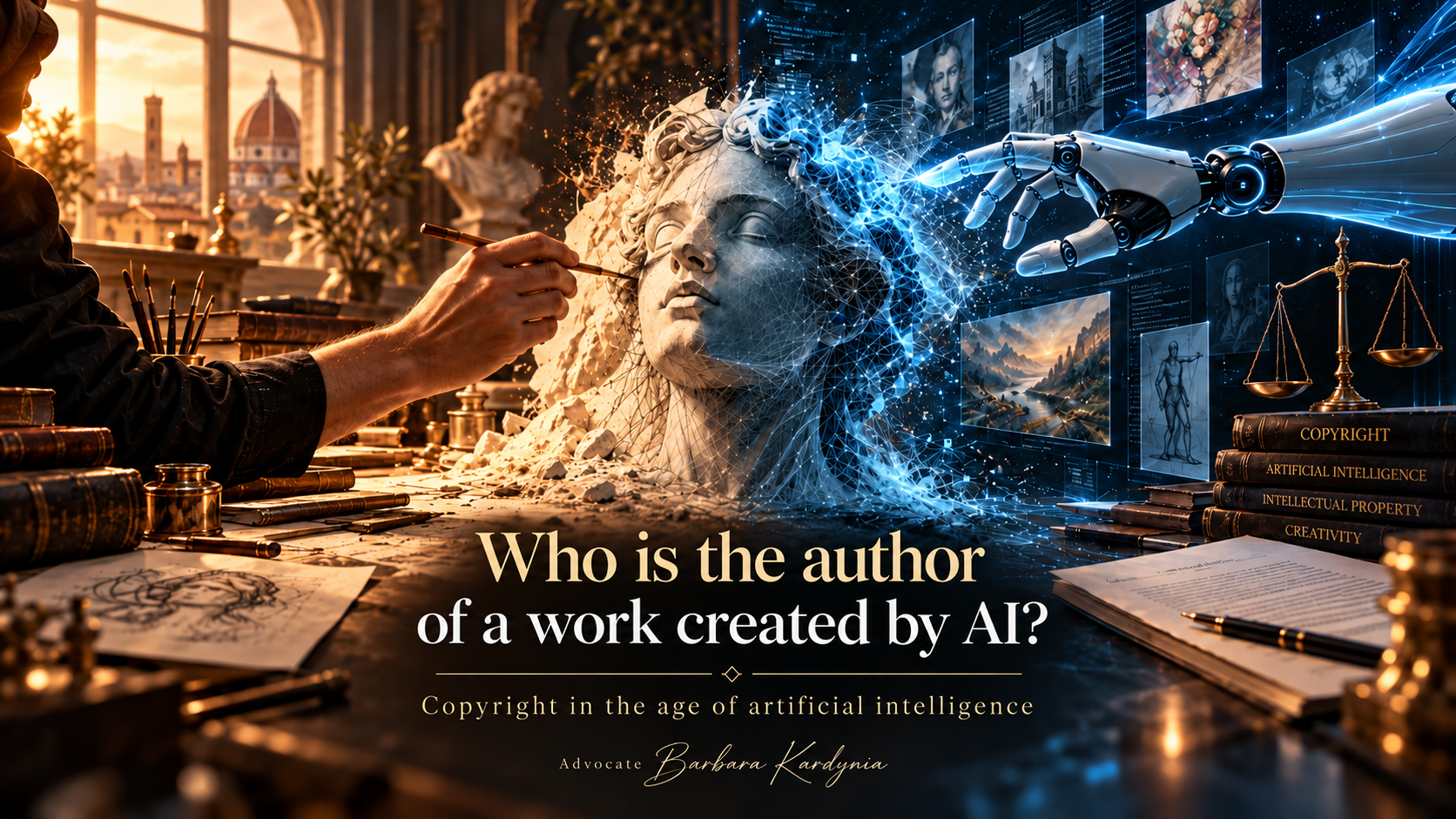
Does a person who gives instructions to artificial intelligence acquire copyright in the resulting work?
Artificial intelligence can now paint a picture, write a story, compose music or design a logo in seconds. Its outputs are often difficult to distinguish from human creations. Yet a fundamental legal question remains: who is the author? The person who entered the prompt? The business that developed the AI system? Or perhaps the AI itself?
The answer is more complex than it might appear. Recent European case law indicates that copyright protection depends on the human creative contribution, rather than the mere use of technology.
Can artificial intelligence be an author?
Under Polish copyright law, the answer is generally no. Under Article 1(1) of the Act on Copyright and Related Rights, protection covers any manifestation of creative activity of an individual character, established in any form. Article 8(1) provides that copyright belongs to the author unless the Act states otherwise.
Within the current copyright framework, an author is a human being whose individual intellectual activity has produced the work. An AI system is not a natural person and cannot independently acquire moral or economic rights as an author. An image or text generated exclusively by AI, without a genuine human creative contribution, will therefore generally not qualify as a copyright-protected work. A different assessment is required where a person uses AI as a tool to realise their own creative concept.
A 1,700-character prompt: the court refused copyright protection
On 13 February 2026, the Munich Local Court (Amtsgericht München) delivered judgment in case 142 C 9786/25. The claimant had created three logos using generative AI and published them on a website. When another person copied the graphics and used them on their own site, he demanded that their use cease and that they be removed. He argued that he had prepared detailed prompts, tested options and repeatedly modified the results. One prompt contained as many as 1,700 characters.
The court dismissed the claim. It held that the length of a prompt, the time spent developing it and repeated attempts do not in themselves establish the creation of a protected work. What matters is whether the final result perceptibly reflects a person’s free and individual creative choices. In this case, the essential decisions about the appearance of the graphics had been left to the AI system, while the detailed instructions described a desired result rather than independently realising a creative work.
The judgment illustrates an important distinction: instructing a system to create a work is not the same as authoring it. At the same time, the court did not rule out protection for an AI-assisted work where human creative elements genuinely shape its final form.
Where does AI’s work end and human creativity begin?
Another decision was issued on 2 April 2026 by the Higher Regional Court of Düsseldorf in case I-20 W 2/26. The dispute concerned a photograph of a dog submerged in water, catching a toy. Another person used the photograph as input for an AI system and generated a comic-style illustration based on it. The photographer alleged copyright infringement.
The court emphasised that copyright protects the individual features of a specific depiction, rather than the general subject of a photograph. It had not been established that protected elements of the photograph were reproduced to an extent justifying the claim. The court also noted that protection of an AI-assisted image itself requires a discernible human creative contribution; choosing one generated option or giving general stylistic instructions is insufficient.
Is editing an AI-generated image enough?
Imagine an artist who asks AI to generate an image of a future city, then independently changes the composition, adds characters, designs the background and introduces original visual elements. Copyright protection will depend on whether those changes are individual and creative. This does not automatically extend copyright to all of the initial AI-generated material; protection covers those elements of the final result that actually meet the requirements for a protected work.
The same may apply to a novel whose initial draft was prepared with AI, but whose plot, dialogue, character development and final language were independently created by a writer. AI then serves as a tool, like a word processor or graphics application. It remains important, however, to demonstrate that human choices, rather than solely the program’s automatic operations, determined the final work’s individual character.
European standards for the protection of creativity
On 21 October 2026, the European Parliamentary Research Service published “Copyright and artificial intelligence-generated outputs”. It identified a clear interpretative direction: content created exclusively by AI, without sufficient human creativity, does not enjoy copyright protection. Using AI as a tool does not, however, preclude protection where the work reflects significant, free human choices.
The case law of the Court of Justice of the European Union provides criteria for assessing originality, although the Court has not yet issued a comprehensive ruling on authorship of AI-generated works. In its judgment of 1 December 2011 in C-145/10, Painer, it emphasised the significance of an author’s free and creative choices. A similar standard was developed in the judgment of 4 December 2025 in Joined Cases C-580/23 and C-795/23, Mio and konektra. The mere fact that AI-generated material is new or aesthetically attractive does not replace the requirement of original human creativity.
Does the AI Act determine who the author is?
Regulation (EU) 2024/1689, known as the AI Act, does not establish separate rules on the authorship of AI-generated content. It regulates, among other matters, transparency obligations relating to certain synthetic materials. Article 53 also sets out obligations for providers of general-purpose AI models concerning compliance with EU copyright law and information about the content used to train models.
In certain circumstances, Article 50 requires AI-generated or manipulated content to be marked, or its artificial origin to be disclosed, subject to the exceptions provided. Such labelling does not determine who the author is or whether the material qualifies as a protected work. The obligation to disclose AI use and the existence of copyright are two separate issues.
Could the company that owns the AI system be the author?
Merely owning or developing an AI system does not make a business the author of the material generated with it. A company may hold rights in software, documentation, trade marks or other elements of the technology, but those rights are separate from rights in individual outputs. In particular, ownership of a tool does not confer authorship of an image, text, piece of music or composition produced using it.
Authorship must be distinguished from ownership of economic copyright. A legal person does not become the creator for the purposes of moral rights, but may acquire economic rights in a work created by a human being. Those rights may be acquired by contract or, in cases specified by legislation, by operation of law. For example, under Article 12 of the Polish Copyright Act, an employer generally acquires, upon accepting a work, economic rights in a work created by an employee in the performance of their employment duties, within the limits arising from the purpose of the employment contract and the parties’ common intention, unless legislation or the contract provides otherwise. Article 74(3) contains a separate rule for computer programs.
Thus, if a graphic designer employed by a company uses AI to develop a design, but the designer’s own creative choices determine its individual character, the designer remains the author of the protected elements. The company may hold economic rights under the contract and applicable law. However, if the final graphic was generated without a human creative contribution — exclusively by AI — it does not meet the requirements for a protected work. It does not enjoy copyright protection, and there are no economic copyright rights that the company could acquire merely because it owns the AI system.
Can an AI platform’s terms determine ownership of the output?
AI providers set out rules for the use of generated content in their terms of service. For example, OpenAI’s terms applicable in Europe provide that, as between OpenAI and the user and to the extent permitted by law, rights in generated outputs belong to the user; the provider assigns any rights it may hold. The terms also state that outputs may not be unique and other users may receive similar content.
This type of contractual provision governs the relationship between the parties, but does not replace the statutory requirements for protection. It cannot create copyright in material that does not qualify as a protected work, or deprive third parties of their rights. A statement that “the user owns the output” must therefore be distinguished from a claim that the user has acquired exclusive economic copyright enforceable against everyone. The terms of the particular service and the type of account used must also be checked in each case.
Can you sell an image, graphic, music or text in which nobody holds copyright?
The absence of copyright protection does not automatically prohibit commercial use of AI-generated material. In principle, it may be shared, used in advertising, or sold in the form of particular copies or services relating to its production, provided this does not breach legislation, the tool’s terms of use or third-party rights.
However, the ability to use an output must be distinguished from ownership of exclusive economic copyright. If a graphic is not a protected work under copyright law, the user does not acquire exclusivity simply because they generated it first, paid for a subscription or act on behalf of the company owning the AI system. Commercial use may also be limited by trade mark rights, personality rights or unfair competition rules, for example.
Legal sources and case law
- Polish Act of 4 February 1994 on Copyright and Related Rights, particularly Articles 1, 8, 11, 12 and 74(3). Source
- CJEU, judgment of 1 December 2011, C-145/10, Painer, ECLI:EU:C:2011:798. Source
- CJEU, judgment of 4 December 2025, Joined Cases C-580/23 and C-795/23, Mio and konektra, ECLI:EU:C:2025:941. Source
- Amtsgericht München, judgment of 13 February 2026, 142 C 9786/25. Source
- Oberlandesgericht Düsseldorf, decision of 2 April 2026, I-20 W 2/26. Source
- European Parliament, EPRS, Copyright and artificial intelligence-generated outputs, 21 October 2026. Source
- Regulation (EU) 2024/1689 (AI Act), particularly Articles 50 and 53. Source
- OpenAI, Europe Terms of Use, updated 16 January 2026 (rights in outputs). Source